P.R.O.W.L.S.
When behaviour looks like disobedience
Loose lead walking is one of those areas of gundog training where misunderstandings show up very quickly.
A guardian will often say something along the lines of, “But they know how to do it. They’re just choosing not to.” From their perspective, that conclusion makes sense. The dog has walked nicely before. They have seen moments when the lead is slack and everything feels calm. Then suddenly the dog is pulling, scanning, forging ahead, or zig zagging with its nose in the wind.
It can feel as though the dog has simply decided that the rules no longer apply.
Looking at the wider picture
But when you spend enough time watching gundogs out in the real world, a different picture begins to emerge.
The dog that is pulling is rarely making a calculated decision to ignore their guardian. Much more often, that dog is simply struggling to cope with the moment they are in. Their senses are busy. Their nervous system is activated. Their instincts are scanning hedgerows, movement, scent, sound, and the many tiny signals that the human beside them cannot even perceive.
From the dog’s perspective, the world is suddenly very loud.
At the same time, there is another layer that is just as common, and it is one that is easy to overlook. Many dogs pull simply because the rules of loose lead walking have never been made truly clear to them. The guardian may have asked for a loose lead at times, but allowed pulling at others. The dog moves forward, sometimes the pressure matters and sometimes it does not, and from the dog’s point of view the boundaries of the game become blurry.
So, we end up with a dog who is both stimulated by the world around them and unsure about what their human is actually asking for.
When we pause long enough to see that clearly, the conversation around behaviour begins to change. Instead of asking, “Why won’t they listen?” we begin asking a more useful question, which is “What is happening for them right now?”
Introducing the PROWLS Lens
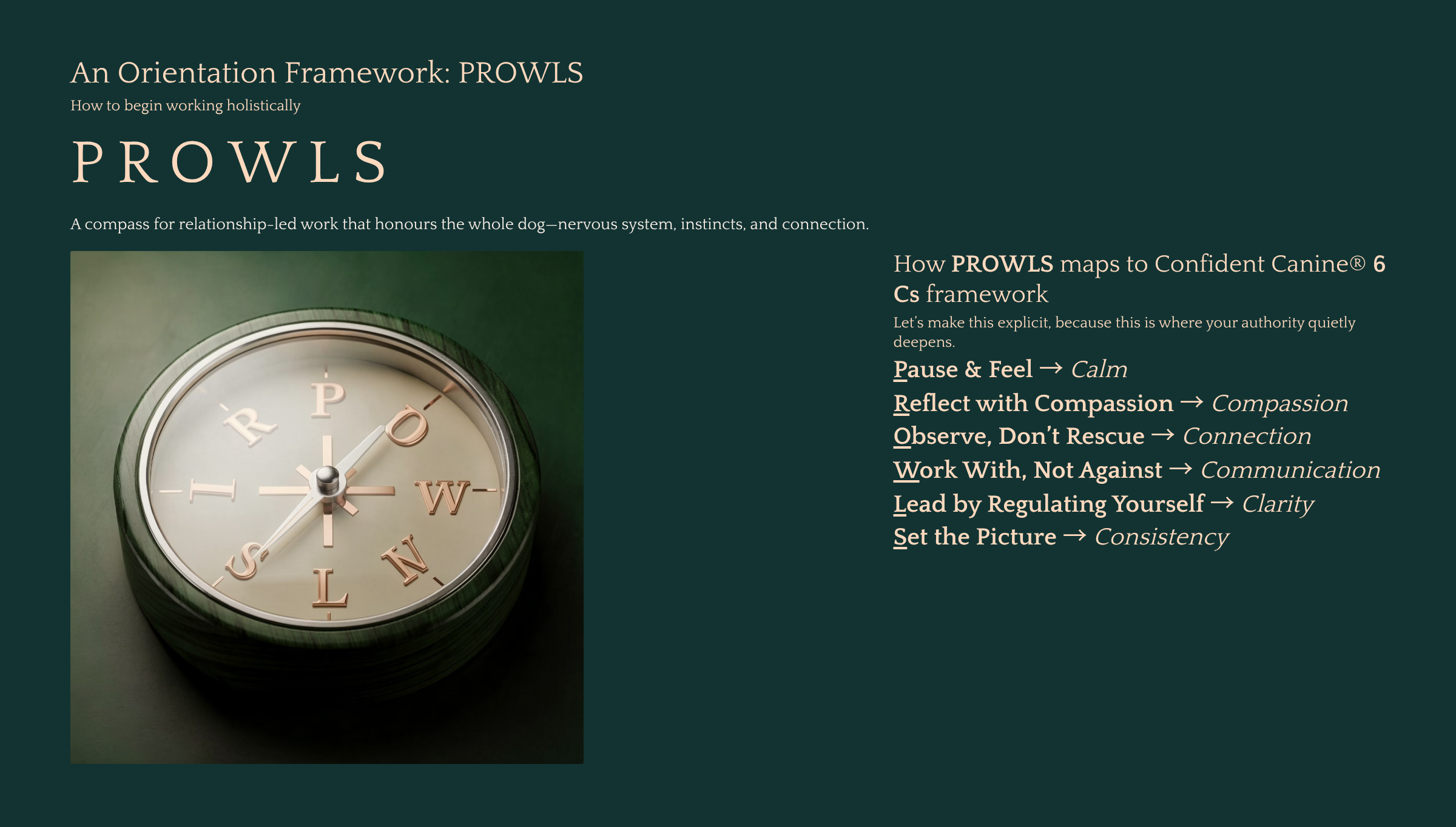
This is where the P.R.O.W.L.S. lens comes in.
Over time I realised that many guardians benefit from having a simple way to slow their thinking down before reacting to behaviour. When something goes wrong on a walk, there is often an instinctive urge to correct the dog or repeat a cue. Yet those reactions rarely solve the real issue if the dog is already overwhelmed or unclear about what is being asked of them.
P.R.O.W.L.S. is simply a way of reminding ourselves to widen the lens before responding.
It begins with Pause and Feel, allowing both human and dog a moment to settle so the situation can be approached with calm rather than urgency. From there we Reflect with Compassion, recognising that the dog’s behaviour is not a personal challenge but information about what they are experiencing.
Next comes Observe, Don’t Rescue. Instead of immediately stepping in or trying to control every moment, we watch carefully and allow the dog space to process what is happening around them. Then we Work With, Not Against the dog’s instincts and natural responses, using them as part of the conversation rather than trying to suppress them.
The next step asks the guardian to Lead by Regulating Yourself. Dogs read our nervous systems far more clearly than our words, and when we regulate ourselves, we create clarity for the dog beside us. Finally, we Set the Picture, establishing clear and consistent expectations so the dog understands what the partnership requires of them.
When you step back and look at behaviour through that lens, something interesting begins to happen.
The pulling on the lead stops looking like stubbornness or defiance. Instead, it becomes a piece of information. It tells us something about the dog’s internal state, the environment around them, or the clarity of the communication between dog and guardian.
What I often see in sessions is that the most powerful shift does not come from teaching the dog something new. It comes when the guardian begins to observe their dog differently. They notice when the dog’s breathing changes, when their head lifts, when their attention moves away, or when their body becomes tighter on the lead.
Those small observations are incredibly valuable. They tell us when the dog is beginning to struggle long before the pulling starts. They also tell us whether the dog is overwhelmed by the world around them, or simply unsure about the expectations that have been set.
Once the guardian can see that picture, their response naturally changes as well. Instead of reacting with frustration, they reset. They slow their pace, soften their body language, clarify the boundary of the lead, or allow the dog a moment to settle and reconnect.
The dog, in turn, experiences something different. Rather than feeling pressure layered on top of confusion or overwhelm, they feel clarity and support from the person beside them.
This is where partnership begins to develop.
Frameworks like P.R.O.W.L.S. are not really about controlling behaviour. They are about helping the human step into a more observant, thoughtful role in the relationship. When the guardian learns to pause, notice, and interpret what the dog is experiencing, behaviour begins to make much more sense.
And once behaviour makes sense, training stops feeling like a battle.
Instead, it becomes a conversation.
Most of the time, the dogs we work with are not refusing to listen. They are navigating a world that is rich with scent, movement, and stimulation while also trying to understand what their human is asking of them.
When we slow down long enough to observe that world through their eyes, our responses naturally become calmer, clearer, and more effective.
Very often, that moment of observation is where the real change begins.