
Why I Start With Regulation
…And Why It Changes Everything
If you’ve landed here, there’s a good chance something isn’t quite working. Maybe your gundog is reactive on the lead. Maybe they can do something perfectly in the garden and fall apart the moment you’re somewhere new. Maybe you’ve tried the training, done the classes, watched the videos, and you’re still stuck.
I want to offer you a different place to start.
Most training skips the most important step
The conventional approach to gundog training begins with behaviour. Sit. Stay. Recall. Leave it. And those things matter. I’m not here to dismiss them.
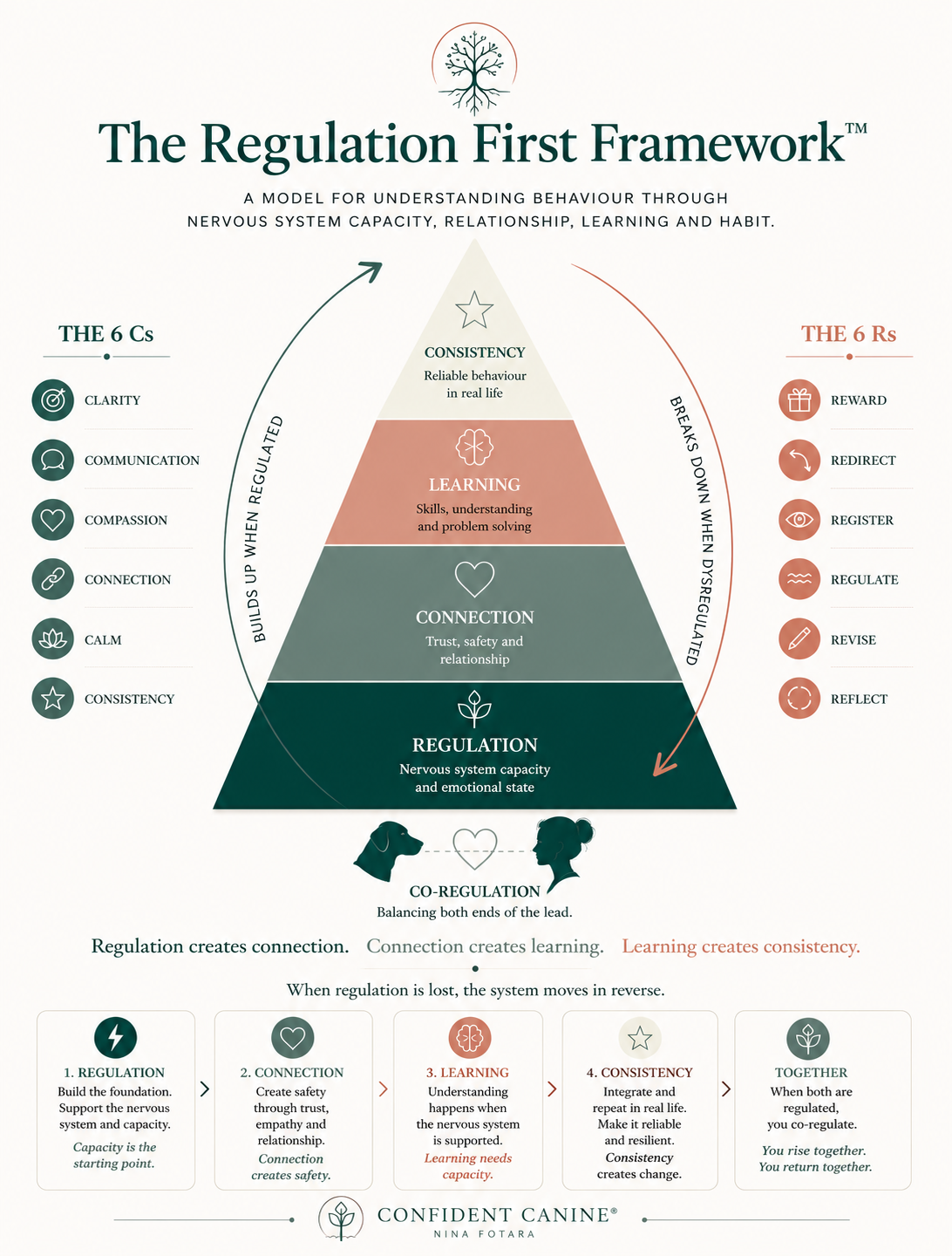
But here’s what gets missed: behaviour is the output. It’s what we see at the surface. Underneath it is a nervous system, and that nervous system has to be in a state where learning is actually possible before any of that training can land the way you need it to.
When a gundog is overwhelmed, over-aroused, or dysregulated, the part of the brain responsible for learning, choice, and connection is not fully available. You can repeat a cue fifty times in that state and get very little back. That isn’t a training problem. That isn’t your gundog being stubborn or stupid or difficult. That is neuroscience.
This is what the Regulation First Model addresses.
So what does Regulation First actually mean?
It means we start underneath the behaviour. Before we ask what a gundog is doing, we ask what their nervous system is doing.
Is this gundog over-aroused? Are they in a state where they can take information in, or are they running on adrenaline and instinct? Is their nervous system capacity stretched to its limit before we’ve even begun?
And then, just as importantly: what about the human at the other end of the lead?
This is the part that surprises most people. Both ends of the lead matter. A handler who is tense, rushing, anxious, or disconnected brings all of that into the interaction. Gundogs are exquisitely sensitive to the state of the people around them. You can have the best training plan in the world, but if you’re frazzled and your gundog is over-threshold, you are not going to find calm together.
Regulation First asks us to look at both ends honestly.
What changes when regulation is in place?
Everything becomes more possible.
When a gundog’s nervous system has enough capacity, learning lands. Connection deepens naturally. Consistency starts to follow, not because you’ve drilled it into them, but because the gundog has the internal space to hold it.
The work stops feeling like a battle. You stop feeling like you’re pushing against something. The relationship shifts.
This is what I see again and again with clients who come to me having tried everything else. The behaviours they’ve been fighting with often begin to soften once we address what’s underneath them. Not always immediately, and not without work, but the trajectory changes.
What does this look like in practice?
The Regulation First Model isn’t a rigid protocol. It’s a framework for understanding what your gundog needs before you ask anything of them, and what you need to bring to the lead for any of that to work.
It means learning to read your gundog’s state, not just their behaviour. It means noticing what your own state is doing. It means building nervous system capacity over time, in your gundog and in yourself, so that the big asks become genuinely achievable rather than a daily source of frustration.
It means understanding that some days your gundog needs you to do less, not more, and that is not a failure. That is the work.
Where to start
If this resonates with you, a good first step is the PAWS® Reset, a simple four-step tool I’ve put together to help you find your footing in the moments when things start to unravel. It takes about thirty seconds and it’s free. [PAWS® Reset link]
If you’d like to go deeper and work through the Regulation First Model™ properly with your gundog, I work with owners one to one and would love to hear where you’re at [contact me to arrange a chat]
You don’t have to keep pushing against the behaviour. There’s a better place to start.